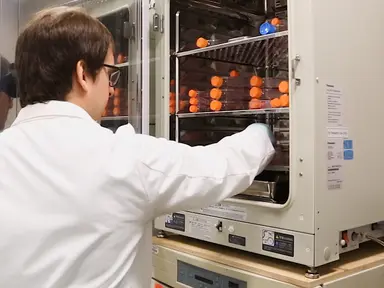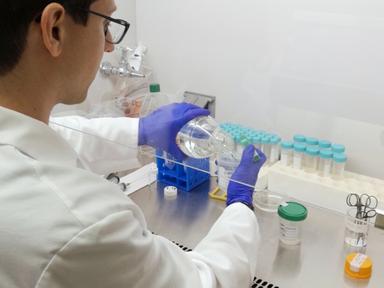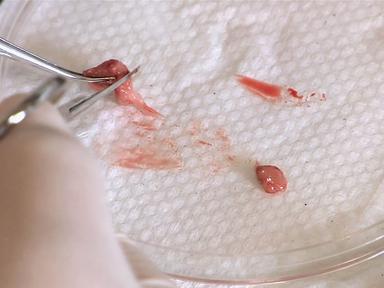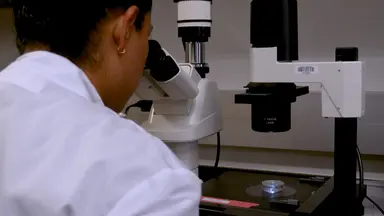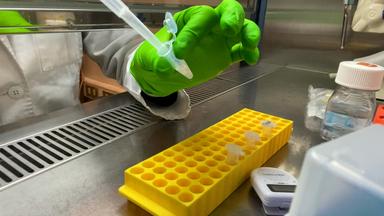
The overall goal of this procedure is to demonstrate the encapsulation of a thermogenic catabolic cell line and its applications in vitro and potentially in vivo. To begin this procedure, prepare a sodium alginate cell suspension and transfer it to a five milliliter syringe. The next step is to use an encapsulation device to produce the alginate microbeads.
The microbeads are then coated with a poly onic poly L lysine solution, and the alginate core is subsequently removed to form a semipermeable membrane around a cell suspension. The final step is to co-culture the encapsulated cells with other cell lines or inject them into the fat tissues of mice. Ultimately, immuno blood analysis shows higher lipolytic activity in adipocytes co cultured with aldehyde dehydrogenase, one deficient adipocyte containing microcaps.
While immunohistochemistry shows successful transplantation of encapsulated cells into the fat tissues of mice, This method can provide insight into thermogenesis and apus tissue. It can also be applied to other existing animal models to provide low cost experimental model system for testing cell subset in vivo. For biomedical discoveries, All procedures should be performed in a level two biosafety cabinet with laminar flow.
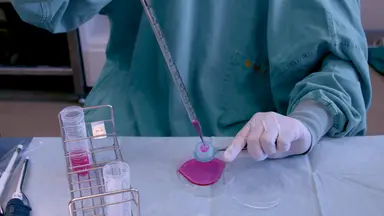
To begin, remove the old medium from the cell culture flask and rinse the preadipocytes with 10 milliliters of PBS. Remove the PBS and resuspend the cells in two milliliters of 0.25%tripsin EDTA. Remove a 10 microliter aliquot from the cell suspension and count cells using a hemo cytometer.
According to the manufacturer's instructions, add DMEM to the remaining cells to get the ideal amount of cells and centrifuge at 480 times G at room temperature for five minutes. After determining the amount of cells needed following the directions in the protocol text, we suspend the cell pellet in an appropriate volume of a 2%sodium algin net solution. Transfer the sodium alginate cell solution to a five milliliter syringe.
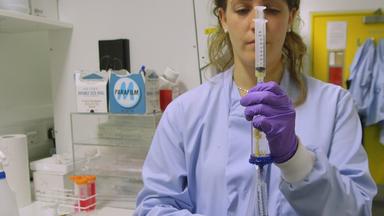
Remove any air bubbles in the solution and invert the syringe to create a one milliliter pocket of air. To prepare for encapsulation, place a small beaker containing 144 milliliters of a 100 millimolar calcium chloride solution. Under the needle spout of the encapsulation device, attach the electrode to the encapsulate with the tip approximately 2.5 centimeters above the surface of the calcium chloride solution.
Place the syringe containing the sodium alginate cell solution Tightly in the syringe pump. Attach the rubber tube to the opening of the syringe. Push the plunger until the sodium alginate cell solution enters halfway through the tube.
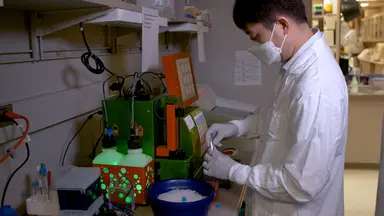
Adjust the voltage to 5.4 kilovolts and set the diameter to 12.06 millimeters on the syringe pump. Adjust the speed to three milliliters per hour. Start the pump, turn on the encapsulate and maintain the voltage at 5.4 kilovolts.
Close the window of the hood and avoid any unnecessary vibrations until the formation of the alginic microbeads is complete. After all of the solution has passed through the needle, solidify the alginate ball shaped microbeads in the calcium chloride solution for an additional 20 minutes before coating with polyanionic polylysine or PLL. Once the sodium alginate cell ball shaped microbeads have solidified, remove the beaker containing the microbeads from the encapsulation device.
Transfer the micro beads into a 50 milliliter centrifugation tube. Remove the calcium chloride solution from the microbead pellet. Wash the microbeads by adding 30 milliliters of a 0.9%sodium chloride solution and gently shaking the tube by hand.
Allow the microbeads to precipitate by gravity. Then use a 25 milliliter pipette to remove the sodium chloride solution in this manner. Wash the microbeads a total of three times.
Next, add the 0.05%PLL solution to the microbeads. Use 10 milliliters of PLL solution for every one milliliter of sodium alginate solution. Vortex at 1000 rotations per minute for 10 minutes, which is usually sufficient for PLL coating.
After confirming the formation of the PLL coat, remove the PLL solution and wash the capsules three times with a 0.9%sodium chloride solution as shown earlier, to remove the alternate core from the PLL coated microbeads first, add 30 milliliters of a 50 millimolar sodium citrate solution to the 50 milliliter tube. Wait for five minutes or until all the sodium alginate is dissolved. Wash the capsules three times with 0.9%sodium chloride solution as shown previously.
After the third wash at 20 milliliters of culture medium to the tube transfer, all the capsules containing the cells to a cell culture flask handle the encapsulated cells under standard cell culture conditions. The host cells for this procedure should be cultured in 24 well plates until confluent. Use fibroblast growth medium prepared as described in the accompanying protocol.
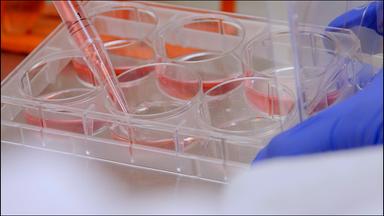
Text for culturing preadipocytes. Transfer the microcaps into the 24 well plate containing confluent host cells add microcaps to achieve a monolayer in each well induce pre adipocyte differentiation with differentiation. Medium one incubate for 48 hours.
After 48 hours, change the media to differentiation.Medium. Two, replace the media with fresh differentiation.Medium.Two. Every 48 hours proteins from the cells will be analyzed by western blot.
Each step of microbead production can be observed under the microscope. An alginate microbead is shown at 20 x magnification. Prior to PLL coating after coding with PLL and after dissolving the ginnet core in a quantitative study expression of adipose triglyceride lipase or A TGL was compared among three T three L one adipocytes co cultured with acellular wild type or aldehyde dehydrogenase one A one deficient adipocyte containing microcaps.
The higher expression of A TGL in adipocytes co cultured with a L DH one A one deficient to dip cyte containing microcaps indicates higher lipolytic activity. In an in vivo study, GFP labeled encapsulated cells were injected into the intraabdominal fat depo of mice. 80 days later, the injected fat pad chose discolored clusters of encapsulated cells.
A paraffin embedded section of the intraabdominal fat depot stained with hemat, toin, and eosin shows clusters of implanted microcaps encapsulated cells and host adipocytes. The same section analyzed under fluorescent light shows GFP labeled transplanted cells on the in inside of round intact capsules. The expression of GFP is also an indicator of cell viability After its development.
This encapsulation technique paved away for researchers in the field of metabolic diseases to explore possible treatments for obesity, insulin resistance in type two diabetes, inflammation, and cancer and modal organisms.