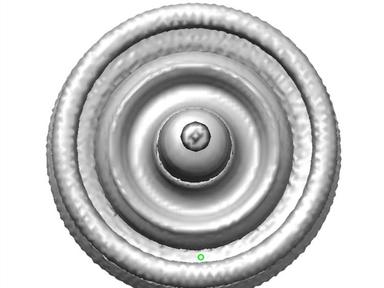
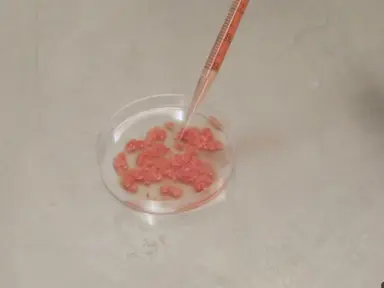
The overall goal of this procedure is to obtain a nonnuclear fraction enriched with replication compartments formed in adenovirus infected cells for the detailed study of their composition, ultra structure and associated activities. This method can help address key questions in the DNA virology field, such as a study of molecular mechanisms that control viral genome replication and expression that in turn depend on replication compartments for regulation of virus host cell interactions. The main advantage of this technique is that it is a simple procedure based on velocity gradient to establish a cell-free system which is amenable to the study of the mechanisms that allow nuclear replicating DNA viruses to take control of the infected cell.
In order to perform this assay, first, prepare adenovirus type five or a D five and human foreskin fibroblasts or HFF as described in the accompanying text protocol to begin infect 10 to the seventh HFF in 100 millimeter tissue culture dishes using one milliliter of 85 and DMM per dish at an MOI of 30 focus forming units or FFU per cell incubate the cells for two hours in a humidified cell culture incubator at 37 degree Celsius and 5%carbon dioxide. Carefully rocking the dishes every 15 minutes to ensure homogeneous distribution of the virus inoculum over the cells. After incubation, remove the medium and add fresh dmem.
Supplemented with 10%FBS then incubate the cells for 16, 24 or 36 hours using a cell scraper. Gently harvest the infected and control cells after infection and collect the cell suspension in sterile centrifuge tubes on ice. Count the cells using a neubauer chamber and then centrifuge the cells at 220 times G for five minutes at four degrees Celsius.
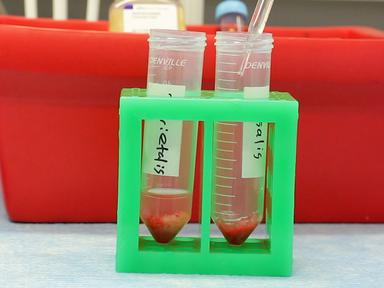
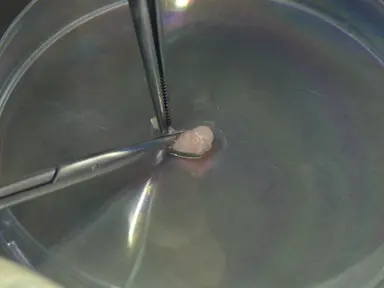
Next, resuspend the cell pellet in five milliliters of ice cold PBS centrifuge and wash the cells three times in five milliliters of ice cold PBS discarding the wash supernatants in order to lice the cells. Resus, suspend the cell pellet in 700 microliters of ice cold hypotonic buffer with protease inhibitors and allow the cells to swell on ice for three hours. Using a type A Teflon pestle, homogenize the cells with 10 to 20 down strokes.
Check the lysate under the microscope periodically every 20 strokes to monitor cell lysis. Repeat the process for about 80 strokes until all the cells are successfully ruptured. Next centrifuge the homogenate at 300 times G at four degrees Celsius for five minutes.
Store the supernatant at minus 20 degrees Celsius in a tube as the cytoplasmic fraction to remove cellular debris from the nuclei reus. Suspend the pellet in 750 microliters of 0.25 molar sucrose solution one pipette 750 microliters of 0.35 molar sucrose solution two in a centrifuge tube and carefully layer the resuspended homogenate over solution two. Spin the sucrose cushion at 1400 times G at four degrees Celsius for five minutes, and then discard the supernatant.
Re suspend the pellet in 750 microliters of solution two to lice. The nuclei sonicate the nuclear suspension in an ultrasonic bath, maintained at or below four degrees Celsius in two five minute pulses. Check nuclear lysis under a bright field microscope between pulses and sonicate further until the nuclei are completely lies.
Next pipette 750 microliters of 0.88 molar sucrose Solution three in a centrifuge tube layer the nuclear lysate solution over solution three. Centrifuge the lysate at 3000 times G at four degrees Celsius for 10 minutes. The 1.5 milliliter S named is the nucleo plasmic fraction, which is stored at minus 70 degrees Celsius.
Then resuspend the pellet in 700 microliters of solution two. This is the 85 replication compartment fraction or RCF of the host nucleus, which is also stored at minus 70 degrees Celsius. To begin immunofluorescence analysis, add a five microliter drop of the RCF to a saline coated glass slide.
Let the drop air dry at room temperature. Then add 500 microliters of PBS in a drop beside the spot and tilt the slide to flow the PBS over the spot. Drain the PBS from the slide.
Next block the sample spot with 500 microliters of PBS containing 5%bovine serum albumin for two hours at room temperature. To remove the excess blocking solution, add 500 microliters of PBS gently to the sample spotted on the slide without pipetting directly on the sample. Perform the wash three times.
Next, add 20 microliters of diluted primary antibody against the viral E two A DNA binding protein on the sample spot. Cover the slide to avoid evaporation and incubate in a humidified chamber at room temperature for two hours. Now, wash the sample thrice gently with PBS containing 0.02%tween 20.
Avoid pipetting directly on the sample following these washes. Add 20 microliters of fluoro four coupled mouse secondary antibody directly on the sample, incubate at four degrees celsius for one hour. In a humidified chamber, add 500 microliters of PBS with 0.02%Tween 20 to the slides, again, avoiding pipetting directly on the sample.
Then add two microliters of mounting solution and invert a cover slip over the sample. Seal the sides of the cover slips with nail polish. View the slide under a fluorescence microscope with a 63 x objective at the desired wavelength specific for the fluoro four used a result from immunofluorescence of adenoviral E two A DNA binding protein or DBP is shown here.
The DBP containing structures are sub nuclear viral rc, note that the E two A DBP is localized within the RC and appears in green. Additionally, enrichment of viral DNA in the RCF was confirmed by PCR comparing the RCF and the nucleo plasmic fraction or NPL at 24 and 36 hours after infection. The viral GNA was selectively found in the RCF and not in the NPL consult.
The accompanying text for additional evidence of adenoviral MNA in the RCF Once master this technique can be done in six from the time infected cells are harvested to the isolation of RCF if it is performed properly. While attempting this procedure, it's important to remember to always keep the samples on ice and monitor the homogenization nucle, isolation, sonication and sub nuclear fraction isolation steps by bright field microscopy. Following this procedure.
Other methods like R-T-P-C-R and transmission electron microscopy can be performed in order to study the regulation of viral gene expression associated to the viral replication compartments and the ultra structure of these particles. This technique has the potential to pave the way for researchers in the field of DNA tumor virology to explore molecular mechanisms that alter cell cycle regulation and promote viral replication in human cells. After watching this video, you should have a good understanding of how to isolate viral replication compartments from infected cell nuclei to perform morphological, functional and compositional studies of these virus induced structures.
Don't forget that working with a SAN indicator can be hazardous, and percussions, such as wearing ear mouths should always be taken while performing this procedure.