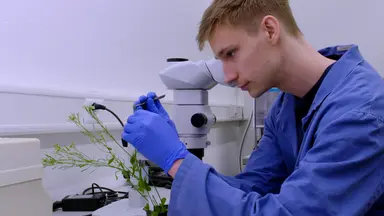
Work in our laboratory aims to understand the molecular basis of pollen-stigma compatibility in the Brassicaceae family of angiosperms, in particular, to identify the pollen and stigmatic factors that regulate successful pollination, specifically those that act at the very earliest stages of plant reproduction. The biggest experimental challenges are identifying candidate genes and proteins that could be involved in pollen-stigma signaling. Once the candidate is identified, mutational studies are required to determine their function.
Our research has shown that a family of small pollen coat proteins, termed the PCP-Bs, are important regulators of pollen hydration and pollen-stigma compatibility in Arabidopsis thaliana. These findings paved the way for further advances in understanding the perception of the pollen signals and how stigmas relay them. To date, a standardized protocol for measuring pollen hydration in Arabidopsis has been lacking, making comparisons of data sets difficult.
Providing a detailed protocol for a pollination bioassay may facilitate ongoing research and provide an easily accessible toolkit for scientists interested in this field. The published protocols often rely on excising stigmas from flowers prior to initiating pollination, which may have physiological consequences affecting pollen hydration. The present method bears the closest resemblance to the in vivo situation and is more precise in collecting individual data points.
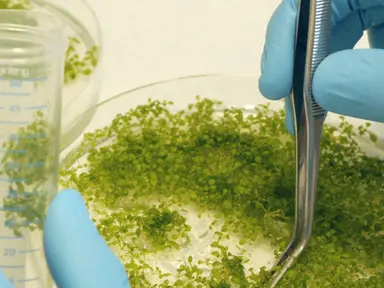
Our laboratory is focused on uncovering new pollen-borne hydration determinants and their stigmatic partners. Our recently published work explored the pollen coat protein for Arabidopsis thaliana, revealing that the pollen surface contains many small ligand-like proteins, strongly suggesting that multiple factors determine pollen-stigma compatibility. Begin by stratifying eighT Arabidopsis seeds in sterile Milli-Q water for three days at four degrees Celsius.
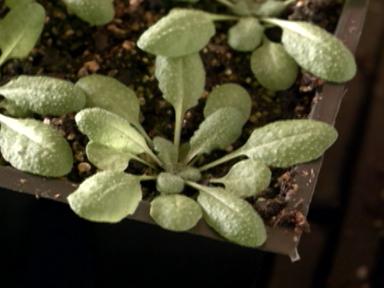
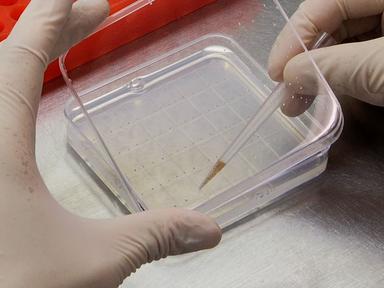
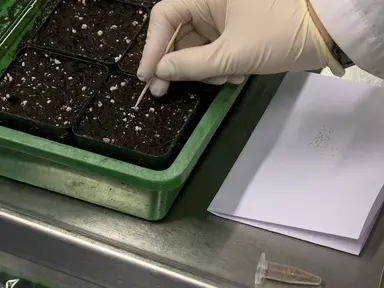
Transfer the stratified seeds to the compost pots by pipetting the stratified seeds. Place the pots in an environmentally controlled growth chamber for approximately six weeks until the in-flora senses are well-established. To ensure synchronous flowering, sow the pollen donor and recipient plants and any other appropriate control plant lines together.
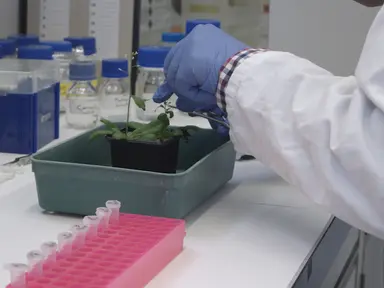
One day prior to the bioassay, select these Stage 12 floral buds from the recipient plant, having unopened flower buds that will show the opening of the flower and the anther dehiscence on the following day. Next, place a glass slide under a stereo dissecting microscope. Tape the region of the stem close to the selected recipient flower on that glass slide.
Using a pair of fine-tipped forceps, carefully tease open the flower bud and remove all the flower petals and anthers. Once done, ensure that the pistol is undamaged and the stigma is free of contaminating pollen. Begin the assay by laying the labeled A thaliana pollen recipient plant on its side, positioning the emasculated flower on the stage of an inverted microscope to image the stigma.
To affix the position of the emasculated recipient flower, immobilize the stem using strips of masking tape. From the pollen donor plant, remove a healthy and freshly opened flower, and place the pollen donor plant under a dissecting microscope. Gather pollen grains using fine-tipped forceps.
Remove excess pollen grains by lightly touching the forceps against the donor pedals until the pollen grains monolayer is formed. Return to the pollen recipient plant, and use a low-power objective lens to focus the inverted microscope on the stigma. Holding the forceps along the opening between the arms of the forceps, carefully approach an unpollinated stigmatic papilla cell.
Continue approaching the unpollinated stigmatic papilla cell until the suitably positioned pollen grain on the forceps makes light contact with its surface. Once pollen attachment is confirmed, slowly withdraw the forceps. Orient the pollen grain with its equatorial axis visible and in sharp focus, and immediately switch to a higher power objective lens, like 20x.
Capture the first pollen grain image as T0 and continue capturing images at one minute intervals for 10 minutes. Adjust the focus to accommodate small movements in the pollen grain or stigma. Record the room's ambient temperature and relative humidity every two minutes, allowing future comparisons between experimental replicates.
Save the images in a lossless format, such as nd2, before repeating the pollination and imaging steps for additional pollen grains to acquire data for control and experimental pollination. Begin the data measurements for pollen hydration assay using image analysis software. Use similar parameters of digital zoom and the approach defining the pollen boundary for all measurements in the data sets.
Record the semi-minor access values for all time points in the dataset. Once the measurements are complete for a dataset, export the raw semi-minor access values of each individual time point to a spreadsheet. Present the data in columns per image stack and calculate the percentage semi-minor access change.
Repeat the steps, and obtain data from at least 15 hydrated pollen grains for each plant line. A few pollen grains may fail to hydrate or may hydrate significantly slower than expected. They are known as dud grains.
Exclude these from the dataset. Calculate the mean values for each time point per plant using the specialized software package GraphPad Prism. Analyze the hydration data from wild type and mutant lines at each time point using unpaired T-tests and One-way ANOVA to compare the means of the specific time point of interest.
To compare the means across all the time points, perform multiple T-test between wild type and mutant lines across multiple time points. The pollen hydration time series data for wild type plants collected on different days showed that the minimum and maximum values for the means between replicates for all time points were within 3%This representative data for wild type pollinations demonstrated a high degree of consistency for relatively low sample numbers and across different days.