Biofilms are composed of live microbial cells and are difficult to remove from the surfaces. Acinetobacter strains, commonly found in our environment causing those common infections, are also known to form biofilms on surfaces. So, we aim to develop methods to both quantify and visualize Acinetobacter biofilms.
Our protocol provides a simple and easy method to quantify and visualize the biofilms of Acinetobacter. The viable number of cells inside the biofilms is quantified by using the viable count method. Our research findings reveal that the naturally existing Acinetobacter strains have quite varying potentials for biofilm formation.
Also, there exist distinct morphological differences within the various biofilms. This paved the way for research focusing on the causes of such a large variation among Acinetobacter strains. To begin the process of bacterial inoculum preparation, collect 2 to 10 microliters of the bacterial strain from the vial using a sterile pipette tip, and inoculate a commercially available blood agar plate with it.
Using a sterile loop, streak the agar surface, thinning it out with intermittent flaming. Incubate the prepared agar plate in an upside-down position at 30 degrees Celsius for about 20 to 24 hours. Next, select a single colony of the bacterial culture with a sterile needle, and inoculate five milliliters of sterile BHI broth with this culture.
Incubate the inoculated broth in a shaking incubator at 30 degrees Celsius, at a speed of 150 rotations per minute, for about 20 to 24 hours. Then transfer one milliliter of the culture to a sterile microcentrifuge tube, and centrifuge at 6, 000 g in room temperature for 10 minutes. Following centrifugation, discard the supernatant.
Add one milliliter of sterile phosphate-buffered saline, or PBS, to the pellet and resuspend it using a vortex. Centrifuge the resuspended pellet at 6, 000 g for 10 minutes at room temperature, and discard the supernatant. This time, resuspend the resulting pellet in sterile tenfold-diluted BHI broth using a vortex.
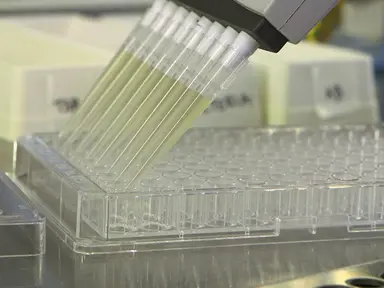
Ensure to achieve an optical density of around 0.1 at 600 nanometers. To begin, add 200 microliters of the bacterial inoculum to each well of a sterile polystyrene 96-well plate. Then add 200 microliters of deionized water into the outermost wells to keep the inner wells from drying out.
Incubate the 96-well plate at 25 degrees Celsius for 24 hours. Following incubation, discard the supernatant in each well using a pipette. Carefully add 300 microliters of PBS to each well, and remove the PBS again by using the pipette.
Add 200 microliters of 1%crystal violet solution to each well before incubating the plate at room temperature for 30 minutes. Then, after dispensing 200 microliters of absolute ethanol in each well, leave the plate for 15 minutes at room temperature. Ensure thorough mixing by pipetting the contents in each well up and down repeatedly.
Using a microplate reader, measure the absorbance of the wells at 595 nanometers to determine the biofilm mass. The number of biofilms varied greatly depending on the strains, ranging from an optical density, or OD, value of 0.04 to 1.69. Of the Acinetobacter isolates, except for A.bouvetii, formed biofilms.
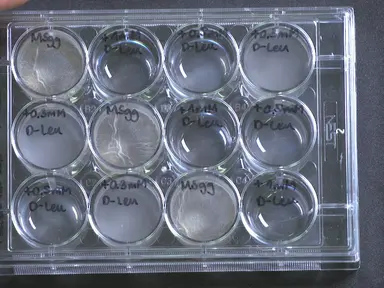
Where A.radioresistens formed a weak biofilm, A.junii and A.bohemicus formed moderate biofilms, and A.pittii and A.ursingii formed strong biofilms. Begin by adding one milliliter Of the bacterial inoculum to each well of a sterile polystyrene 12-well plate. Incubate the plate at 25 degrees Celsius for 24 hours.
Then, remove the supernatant using a pipette. Carefully add 1.5 milliliters of sterile phosphate-buffered saline, or PBS, to each well. And again, remove the supernatant with the pipette.
After adding one milliliter of sterile PBS to each well once more, use fitted cell scrapers to scrape off the bottom and wall surfaces of the wells. Transfer the harvested cell suspension to a sterile plastic tube marked as 10 to the negative 1, containing nine milliliters of saline and 10 to 20 glass beads. Vortex the tube for 60 seconds at maximum speed.
Next, perform a tenfold serial dilution by transferring one milliliter of the cell suspension from the previous tube to another sterile tube marked 10 to the negative 2, containing nine milliliters of saline solution. Continue this process of serial dilution up to tube 10 to the negative 7. Spread 100 microliters from each dilution onto separate Acinetobacter agar plates.
Incubate the agar plates at 30 degrees Celsius for 24 to 42 hours. Then count the number of typical red colonies on each plate manually. Considering those within the range between 10 and 250.
All the Acinetobacter isolates, except for A.bouvetii, had cells equivalent to seven to eight log CFU per well in their biofilms. Where A.bouvetii had a much lower cell number at 4.4 log CFU. Begin by adding 200 microliters of bacterial inoculum into each well of a sterile 96-well plate prepared for microscopic analysis.
Incubate the plate at 25 degrees Celsius for 24 hours before removing the supernatant with a pipette. Next, carefully add 300 microliters of filter-sterilized deionized water into each well. Remove the supernatant using a pipette once again.
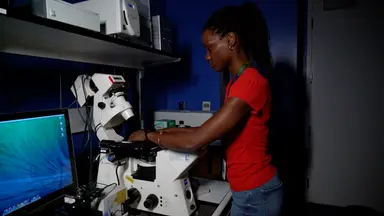
In another tube, prepare a diluted mixture of SYTO9 and propidium iodide and filter-sterilized deionized water to the respective desired final concentrations. Then add 200 microliters of the mixture into each well and incubate the plate for 20 to 30 minutes at room temperature in a dark setting. Confocal laser scanning microscopy revealed that biofilm formation significantly varied depending on the strains.
A substantial amount of biofilm was found in Acinetobacter junii, Acinetobacter baumannii, and Acinetobacter ursingii, with distinct biofilm morphologies.