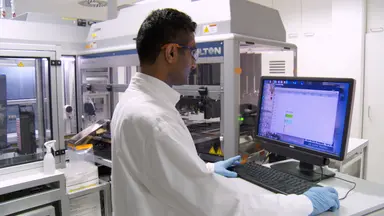
We construct phenotypic profiles of differentiated human cells such as neurons. Our goal is to better understand the overall effects of chemical compound treatments on the cells. Phenotypic profiles can suggest less biased entry points for further mechanistic studies.
The quality of protocols for differentiating human dopaminergic neurons has significantly improved, enabling the production of large batches of homogeneous neurons. Additionally, there is a rise in the use of lab automation for handling differentiated cells reproducibility over extended periods, and of course, the exploitation of imaging based data has become faster and more detailed. A big challenge is to ensure that phenotypic profiles are both quantifiable and reproducible.
To achieve this, it is crucial to produce homogeneous neuron batches and identify an automation suited protocol. However, with an automated protocols, there is always a trade off between technical feasibility and physiological relevance. Here we found a good trade off.
We developed a ready to use solution to thoroughly characterize human dopaminergic neurons using an imaging approach. The automated protocol, along with the image and data analysis workflow will equip more scientists to create neuronal phenotypic profiles. We would like to better understand how phenotypic profiles differ between monogenetic and idiopathic forms of Parkinson's disease.
We would also like to explore the changes in phenotypic aspects when dopaminergic neurons interact with other brain cell types such as microglia, for example. To thaw the neurons on the day of seeding, prewarm the water bath to 37 degrees Celsius. Also, equilibrate the complete maintenance media to room temperature while protecting it from light.
Meanwhile, remove the vial containing the commercially obtained frozen neurons from the liquid nitrogen tank and transfer it to dry ice. Then, place the vial in the water bath at 37 degrees Celsius for two minutes to ensure complete thawing, following which, disinfect the vial using 70%ethanol. Using a P1000 pipette transferred the approximately 370 microliters of thawed neurons from the vial to a 50 milliliter centrifuge tube.
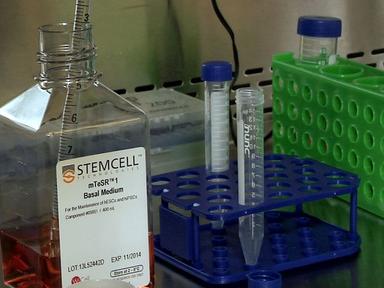
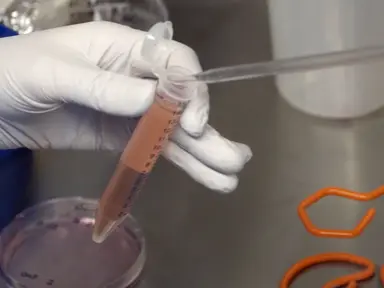
Rinse the empty vial with 630 microliters of complete maintenance medium, and using a pipette, dispense the medium dropwise into the 50 milliliter tube at a 45 degree angle. In a similar manner, using a P1000 pipette, add one milliliter of complete maintenance medium to the 50 milliliter centrifuge tube. Then, slowly add an additional two milliliters of complete maintenance medium into the tube.
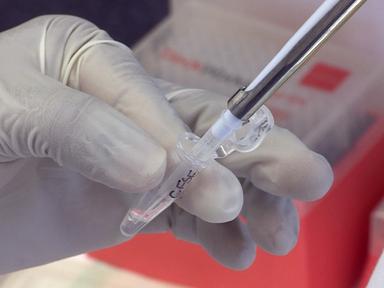
Next, mix 10 microliters of trypan blue with 10 microliters of the cell suspension in a microtube. Then add 10 microliters of the mixture to a counting chamber slide for counting cells. Following cell counting and transferring the neurons to a 15 milliliter tube, centrifuge at 400 G for five minutes at room temperature.
Subsequently, remove the supernatant. Using a P1000 pipette, carefully resuspend the neuron pellet in one milliliter of complete maintenance medium. Finally, add the necessary volume of medium to achieve the desired concentration for seeding the neurons on the same day.
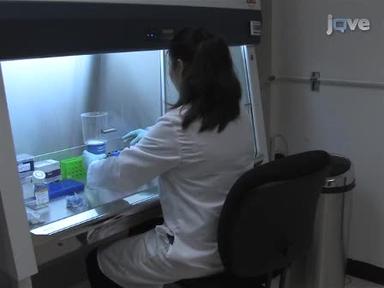
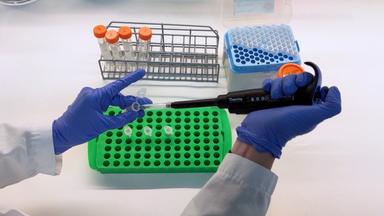
To begin, take the poly-d-lysine pre-coated 384 well plate containing 25 microliters of laminin per well out of the refrigerator and equilibrate the plate to room temperature for about 30 minutes under the cell culture hood. Just before seeding, aspirate 15 microliters of coating solution from each well, using an automated liquid handler or a 16 channel pipette. Then, dispense 50 microliters of cell solution containing 300, 000 neurons per milliliter into each well.
Avoid filling cells in columns one, two, 23, and 24, and rows A, B, O, and P to minimize possible edge effects. Fill those unused wells with 80 microliters of phosphate buffered saline. Incubate the plate at 37 degrees Celsius under 5%carbon dioxide.
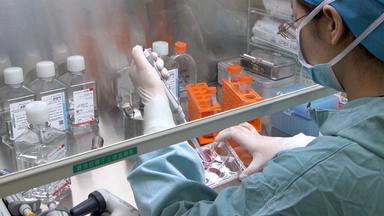
Prewarm an appropriate volume of complete maintenance medium at room temperature and away from light. Prepare a 1.5 times concentrated compound solution for all desired concentrations to be tested using complete maintenance medium for dilutions. Using automatic pipetting system, discard 40 microliters of medium per well from the neuron containing plate, leaving 20 microliters of medium per well.
Then, add 40 microliters of the 1.5 times concentrated compound solution per well to achieve the desired final concentration. Following the desired protocol, healthy donor or LRRK2 G2019S mutation carrying midbrain dopaminergic neurons were successfully cultured for six days and treated with either dimethyl sulfoxide or LRRK2 kinase inhibitor. The neurons were stained with nuclear stain and antibodies against alpha synuclein, tyrosine hydroxylase, and MAP2.
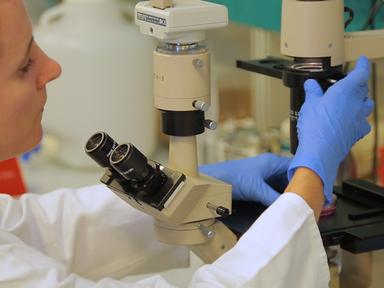
To process the images of the fluorescently stained neurons acquired using a confocal fluorescence microscope, use PhenoLink software for image segmentation and feature extraction. In the software, load the plate of choice to access the data and select a desired image. To perform image segmentation on the illumination corrected raw images, adjust the fluorescent intensities to visualize the different channels.
Empirically, determine the respective channel intensity thresholds per plate to ensure the desired segmented signal corresponds to the signal in the raw image and minimize the background signal. To separate living from dead cells, define the nucleus size and intensity thresholds. Measure the size of the nucleus by double clicking and visualize the displayed intensity.
When using 40x images, maintain default parameters and run the processing. With the resulting tabular quantitative data, construct phenotypic profiles to compare different cell lines or treatment conditions. Execute the Jupyter notebook cell by cell using the Jupyter software for phenotypic profile generation and visualization.
Images were segmented and phenotypic features were extracted. A total of 126 quantitative features that could be aggregated into well-based phenotypic profiles were determined. Some features showed changes upon compound treatment.
For example, the alpha synuclein fluorescence intensity in tyrosine hydroxylase or TH positive cells, decreased upon treatment with the LRRK2 kinase inhibitor, PFE-360. Other features like the MAP2 neurite network length or the ratio of TH positive neurons presented differences only between the tested cell lines, but not upon compound treatment.