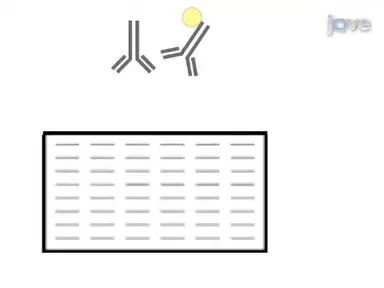
The overall goal of this procedure is to demonstrate the interaction between the antiviral MX one protein and its viral target, the influenza nucle protein via co immunoprecipitation. This is accomplished by first lysing transfected cells containing both proteins in the presence of ide. The second step is to add a nuclear protein specific antibody to bind to the influenza nuclear protein and the interacting MX one protein.
Next, the resulting immune complexes are precipitated with protein G beads and the contaminating proteins are removed through extensive washes. The final step is to elute the influenza nuclear protein and the coun precipitated MX one protein from the protein G beads. Ultimately, western blotting is used to show the interaction between the influenza nuclear protein and the antiviral MX one protein.
The main advantage of this technique over existing methods like these two hybrid is that the interacting proteins are suited in their natural environment, which is the human cell. This methods can provide insight into the interaction between the influenza evir nuclear protein, and the antiviral AMX one protein, but it can also be modified to study other weak or transient protein protein interactions. The technique will be demonstrated by during the figure a colleague from my laboratory, Prepare all of the transfection buffers as described in the accompanying text protocol.
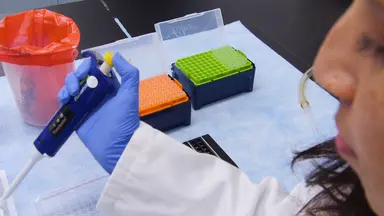
Dilute the plasma DNA into 600 microliters of tris EDTA. Then add 150 microliters of heaps buffered calcium chloride in a dropwise manner to the plasmid samples, and to mix by pipetting up and down three times. Add the result in 750 microliters of plasmid solution dropwise to 750 microliters of heaps buffered saline placed in a fresh six well plate.
Be sure to distribute the plasmid solution evenly over the entire well. Next place the transfection solution on a plate shaker for 90 seconds at 1000 RPMs, and then incubate the mixture at room temperature for five minutes. Take a nine centimeter tissue culture coated Petri dish with HEC 2 9 3 T cells with cells that are sub confluent on the day of transfection.
Using a P 1000 micro pipet, add the transfection solution dropwise to the cells, making sure to disperse the mixture evenly over the entire plate. When all 1.5 milliliters of the transfection solution has been added, gently shake the plate, incubate the cells at 37 degrees Celsius and 5%carbon dioxide for six hours. Then aspirate the medium and immediately replace with 12 milliliters of fresh prewarm, medium gently.
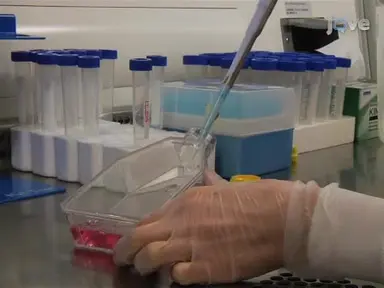
To prevent cell detachment. Prepare allstock lysis solutions as described in the accompanying text protocol. Once prepared, wash the cells with two milliliters of ice cold PBS Perform the wash gently as HEC 2 9 3 T cells detach easily.
Next, remove the PBS and add 600 microliters of ice cold, low salt lysis buffer to each plate and place them on ice for 20 minutes every five minutes, gently shake each plate and make sure the plates are kept horizontal. Collect the cell lysate in a 1.5 milliliter micro centrifuge tube and centrifuge it for three minutes at four degrees Celsius and 16, 000 times G.To pellet, the insoluble fraction. Transfer the soluble fraction to a fresh 1.5 milliliter micro centrifuge tube and place it on ice.
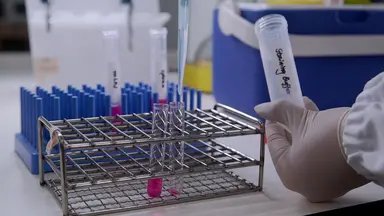
Perform the remaining steps as much as possible on ice or at four degrees to limit the proteolytic activity in the lysates. To prepare the immune complexes mix 135 microliters of lysate with two microliters of anti NP monoclonal antibody and 113 microliters of low salt lysis buffer. For a total volume of 250 microliters, store the remaining lysate at minus 20 degrees Celsius.
For further analysis such as western blotting, incubate the antibody lysate mixture for three hours to overnight on a turning wheel at four degrees Celsius. Next, prepare the protein G beads by adding 100 microliters of bead slurry for each sample to a single tube. Centrifuge the slurry at 8, 000 times g and four degrees Celsius for 30 seconds and remove the ethanol solution in which they are stored.
Add an equal volume of ice cold, low salt lysis buffer, and gently mix centrifuge the protein G bead slurry again at 8, 000 times G and four degrees Celsius for 30 seconds. And then carefully remove the supernatant. Estimate the volume of protein G beads remaining, and add an equal volume of ice cold low salt lysis buffer to make a new 50%bead slurry in low salt lysis buffer res.
Suspend the slurry and transfer 100 microliters into a fresh 1.5 milliliter centrifuge tube. Store the tube on ice until it is needed before using the protein G beads for immunoprecipitation centrifuge, all tubes for 30 seconds at 8, 000 times g and four degrees Celsius. Afterwards, verify by visual inspection that there are equal amounts of beads present in all samples.
If necessary, adjust the amount of beads in some of the samples and centrifuge again. Once all the samples appear equal at approximately 50 microliters, discard the supernatants taking care not to disturb the pelleted protein G beads. Next, briefly, centrifuge the immune complexes for 30 seconds at 8, 000 times G and four degrees Celsius to collect the sample at the bottom of the tube.
Then transfer the entire immune complexes to the protein G beads. Incubate for 60 minutes on a turning wheel at four degrees Celsius To not incubate the beats with the immune complexes for longer than 75 minutes. Incubating for longer amount of time increases the non-specific binding of proteins to the protein G bets.
Then centrifuge the protein G beads with the now bound immune complexes. Remove the supernatants, but be careful not to disturb the pelleted protein G beads. Next, wash the protein G beads for approximately five minutes with 900 microliters of high salt lysis buffer.
Make sure that the beads are completely resuspended in the wash buffer. For optimal washing centrifuge, the protein G beads for 30 seconds at 8, 000 times G and four degrees Celsius and discard the supernatants. Be careful not to disturb the pelleted protein G beads to avoid loss of the immuno precipitated material.
After the last wash step, add 50 microliters of two x lamely sample buffer to the beads and heat the suspension for 10 minutes at 95 degrees Celsius. To elute. The coun precipitated proteins After heating centrifuge, the protein G beads for 30 seconds at 8, 000 times.
G.Then store the samples at four degrees Celsius if they will be used immediately or at minus 20 degrees Celsius for long-term storage. Shown here is a western blot of a co immunoprecipitation experiment where two samples, one, having both the antiviral MX one protein and the influenza A virus, nuclear proteins present, and a control where only the MX one protein is present. This block chose that the MX one protein is only coun precipitated in the presence of co-expressed influenza, A virus nuclear protein.
Here one can see the importance of using the alkylating agent N ide. When preparing the cell lysates in the presence of N ylm, the NP MX one interaction is able to be detected, but in its absence, this interaction is undetectable. This method is very versatile and can be used to evaluate the co immunoprecipitation of MX one with influenza, a virus, nuclear protein from lysates, derived from transfected cells, infected cells, or derived from varians.
After watching this video, you should have a good understanding of how to perform a co immunoprecipitation experiment. Furthermore, addition of an media to the cell lysis allows to study weak or transient protein protein interactions such as the interaction between the influenza, a virus, nuclear protein, and the antiviral Amex one protein.