My research is focused on the plant various movement from cell to cell, and I'm trying to understand the mechanisms of the various plant interactions during the local spread after infection. Recently, we found that plasmodesmata look like the protein file can move from cell to cell in nicotiana benthamiana. These results will help us to understand the mechanisms of plasmodesmata functions in the future.
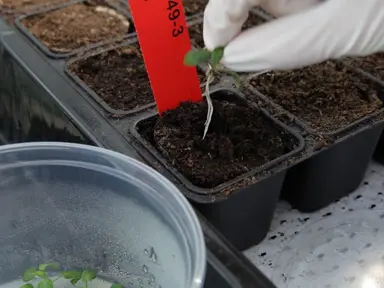
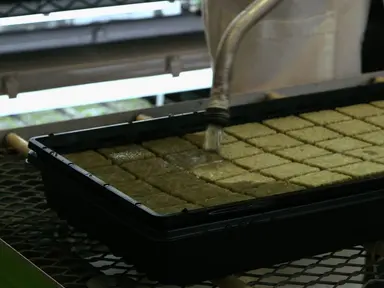
Knowing a protein's subcellular localization is quite important for learning its function. This protocol provides good plasmodesmata localized macros PDLP5 and TVCV MP that can be used in protein localization studies. To begin, grow nicotiana benthamiana seeds in wet soil within a controlled environment chamber, set at 23 degrees Celsius, maintaining 16 hours of light, followed by eight hours of darkness.
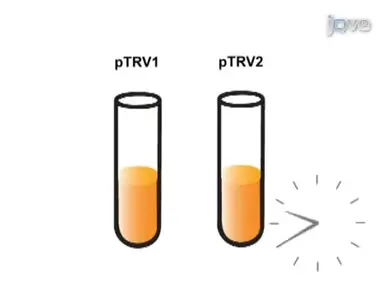
After transferring the two weeks old seedlings to larger pots, grow the plants under the same conditions for four to five weeks to prepare them for agroinfiltration experiments. Streak agrobacterium tumefaciens EHA 105 cells, containing desired vectors onto LB agar plates and incubate them at 28 degrees Celsius. After two days, transfer a single colony from the plate into two milliliters of LB broth and incubate overnight at 28 degrees Celsius with agitation at 250 revolutions per minute.
Then, remove one milliliter from the overnight culture and add four milliliters of fresh LB broth to reculture for one hour under the same conditions. Pellet the cells by centrifugation. After that, determine the cell count of the bacterial suspension at 600 nanometers and adjust the optical density to 0.1 or 0.2, using infiltration buffer.
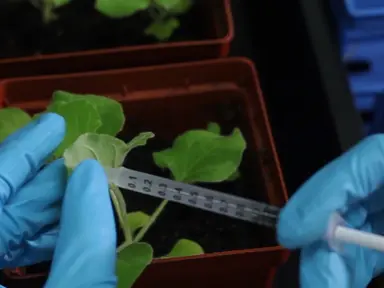
Incubate the bacterial suspension at room temperature for three hours with gentle agitation. Next, infiltrate the abaxial surface of fully expanded leaves from different plants, using a one milliliter needleless disposable syringe. Mark the infiltrated area, which will appear darker than the surrounding non-infiltrated tissue with a waterproof pen.
To begin, obtain nicotiana benthamiana leaves infiltrated with the agrobacterium tumefaciens cells, harboring desired vectors. For visualization of plasmodesmata, add an aliquot of 200 microliters of 1%aniline blue onto a microscope slide. Then, using a blade, excise the infiltrated leaf area away from the vein and transfer it to the aniline blue solution on the slide with the abaxial side up.
Ensure the leaf tissue sample is fully submerged before covering it with a cover glass. Place the slide with the sample in a desiccator attached to a vacuum pump. Evacuate for two minutes at less than 0.8 pascal.
Then, slowly release the pressure and incubate the slide in the dark for 30 minutes at room temperature. Now, visualize the fluorescent signal of aniline blue under a laser scanning confocal microscope. To begin, obtain nicotiana benthamiana plant, infiltrated with the agrobacterium tumefaciens cells, harboring desired vectors.
For protein localization studies, harvest two leaves from two plants at different time points after the infiltration. Using a blade, cut the infiltration zone into slices away from the vein. Place the tissue sample with the abaxial side up on a drop of sterile water at the center of a microscope slide.
Cover the slide with a cover glass, ensuring no bubbles are trapped. Visualize the fluorescent signal of autofluorescent tags in the infiltrated area with a laser scanning confocal microscope. Collect 20 images for each condition using at least two independent biological replicates.
Score plasmodesmata localization of the tested protein based on the diagnostic punctate appearance of the signal at the cell periphery. TVCV MP-EGFP and PDL5-EGFP proteins demonstrated clear punctate localization to plasmodesmata. While PDCB1-EGFP showed localization to both plasmodesmata and endoplasmic reticulum on day one, post infiltration, both MP and PDLP5 began accumulating at plasmodesmata on day one, post infiltration, reaching maximum intensity on day two, and remained stable for five days.
PDCB1 exhibited strong endoplasmic reticulum localization until day three, after which, plasmodesmata localization became visible in fewer cells.