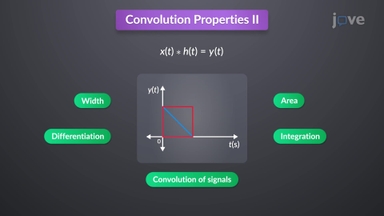
The important convolution properties include width, area, differentiation, and integration properties.
The width property indicates that if the durations of input signals are T1 and T2, then the width of the output response equals the sum of both durations, irrespective of the shapes of the two functions. For instance, convolving two rectangular pulses with durations of 2 seconds and 1 second results in a function with a width of 3 seconds.
The area property asserts that the area under the convolution of two functions equals the product of the areas under each function. Mathematically, if x(t) and h(t) are two functions, then the expression for area property can be given as,

The differentiation property states that the derivative of a convolution equals the convolution of the input signal's derivative and impulse response, or vice versa. This can be expressed as,

Combining these equations and generalizing for higher-order derivatives gives the general differentiation relation.
The integration property indicates that the integral of a convolution yields the convolution of the impulse response and the integral of the input signal, or vice versa. This is mathematically represented as:

If a convolution is performed with a step function, the LTI system behaves like an ideal integrator.
These properties — width, area, differentiation, and integration — are crucial for simplifying and understanding the convolution operations in LTI systems, making it easier to analyze and design complex signal processing tasks.
From Chapter 14:
Now Playing
14.5 : Convolution Properties II
Linear Time- Invariant Systems
138 Views
14.1 : Linear time-invariant Systems
Linear Time- Invariant Systems
169 Views
14.2 : Impulse Response
Linear Time- Invariant Systems
212 Views
14.3 : Convolution: Math, Graphics, and Discrete Signals
Linear Time- Invariant Systems
188 Views
14.4 : Convolution Properties I
Linear Time- Invariant Systems
114 Views
14.6 : Deconvolution
Linear Time- Invariant Systems
107 Views
14.7 : BIBO stability of continuous and discrete -time systems
Linear Time- Invariant Systems
264 Views

Copyright © 2025 MyJoVE Corporation. All rights reserved