The overall goal of this study is to develop a trans-scleral transplantation platform with direct transpupillary-guidance to facilitate the subretinal delivery of cells in mouse recipients. All animal experiments were carried out according to the National Institute of Health Guide. Our statement of the use of animals and approved by the Johns Hopkins University Animal Care and Use Committee.
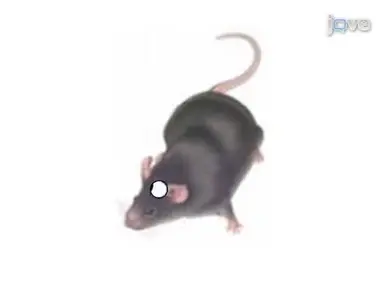
Adopting EGFP mice age at postnatal day 3-6 were used as donors of retinal cell suspensions. OPN1LW-EGFP/NRL mice, age at postnatal day 3 were adopted as retinal sheet donors. Adult retinal degeneration Rd1/NS mice with immune deficiency were used as recipients.
Euthanize donor mice with overdose carbon dioxide. To isolate mice eyeballs, carefully open pups'eyelids using a micro scissor and expose the eyeball. Wrap the optic nerve, and pull out the eyeball with smooth forceps.
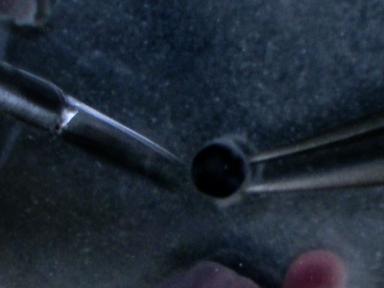
Once the eyeballs are isolated, incise a hole in the center of the cornea using a 25-gauge needle. Cut the cornea in half through the hole. And enlarge the incision to the sclera and RPE.
Then remove the sclera and RPE. Next, use micro-toothed forceps to gently remove the lens and vitreous to isolate the neural retina. To collect the donor retinal suspension, incubate the neural retina in Papain solution at 37 centigrade for 20 to 30 minutes until no cell clumps are detectable.
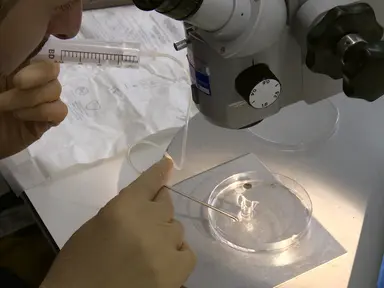
Collect the single cells following the manufacturer's instructions of the Papain kit. To prepare retinal sheet, put the isolated retina into a Petri dish with PBS. Then gently cut the neural retina into multiple retinal sheets with a micro scissor.
Anesthetize recipient mice with an intraperitoneal injection of ketamine and xylazine. Ensure that the plane of anesthesia achieved that is the surgical plane where the animal loses blink and pain reflexes, but breathing and respiration remains regular. Assess the anesthetic depth by tail pinch or the pedal withdrawal reflexes.
Re-check the anesthetic depth during the operative procedure. Keep the mice on the pre-warmed surgery table to avoid hypothermia. Dilate recipient pupils with tropicamide eye drops five minutes before the surgery.
A well-dilated pupil can facilitate transpupillary visualization under the operating microscope. Put a drop of Proparacaine hydrochloride on the mice eye for analgesia. Disinfect the operating mouse eye and surrounding ocular tissues with iodine.
Then clean the eye with sterile PBS. Penetrate the peripheral tunnel into internal chamber to reduce the intraocular pressure. Next, put a drop of sodium hyaluronate and a glass coverslip on top of the cornea.
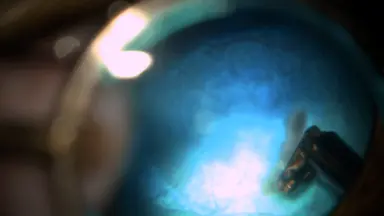
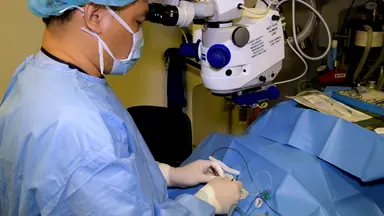
Transpupillary visualization of the mouse fundus is now available under the surgical scope. Expose the injection locus by pushing the eyewall towards the center of the transpupillary visual with toothed forceps. Then partially penetrate the sclera with a microinjection needle, facing 90 degrees to the eyewall.
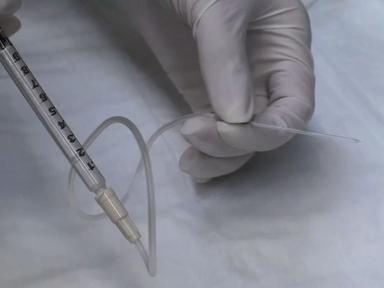
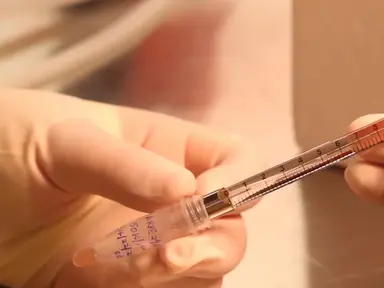
The superficial retinal vessels can serve as an anatomical reference to locate the needle within the subretinal space. Then inject the retinal grafts. The preloaded small bubbles in the syringe can facilitate validation of the subretinal location of donor cells.
If the cornea becomes cloudy, keep the needle in the subretinal space, until the cornea becomes transparent to normalize the intraocular pressure. Grasp the edge of the injection hole and quickly pull out the needle. The criterion for successful delivery of cell suspension is a constant bleb in the subretinal space.
A successful delivery of retinal sheet, is convinced by a visible white sheet. Keep transplanted mice on a pre-warmed clean recovery cage, and carefully monitor them for any distress signs. If this occurs, put a drop of topical proparacaine hydrochloride on the surgical eye for two, three times.
Remove mice back to the house cage after the mice are completely alert and mobile. Place a small number of food pellets in the gel cup on the floor of the cage. If the mice have trouble reaching the food hopper.
Two months post-transplantation, multimodal confocal scanning laser ophthalmoscopy was performed to check the states of retinal grafts seen vivo. Spectral domain optical coherence tomography showed that retinal grafts survived in the subretinal space and reconstitutes the outer nuclear layer of all recipient mice. Infrared imaging detected no obvious cataract in all transplanted mice.
Other surgical complications, including hemorrhage, were badly detected in transplanted mice by multicolor reflectance imaging. Histological staining showed abundant cone photoreceptors expressing OPN1LW:EGFP and S-opsin in transplanted retinal sheets. Likewise, transplanting retinal cell suspensions showed a large proportion of recovering positive photoreceptors in vivo, including numerous mature EGFP positive rods.
The non-transplanted mice showed severe degeneration of outer nuclear layer with sparse residual cone photoreceptors expressing recovery. However, no EGP signal was detected in non-transplanted mice. This study provides a trans-scleral surgical platform with direct transpupillary vision guidance for subretinal transplantation in mouse recipients.
This platform enables precise delivery of known doses of cells. It's relatively easy to learn and facilitate subretinal delivery in addition to intra-retinal or intravitreal injections for different types of therapeutic agents, including gene therapy.