10.9K Views
•
15:19 min
•
June 22nd, 2014
June 22nd, 2014
•The overall goal of this protocol is to characterize the effects of seminal fluid proteins on the egg laying behavior of a simultaneous hermaphrodite species. This is accomplished by first isolating individuals from a standardized lab culture, followed by dissection of target organs. Second, the sperms collected and a treatment solution is made.
After this, the snails are artificially inseminated. Then they're put in a bio essay. Under standard conditions, the egg masses are collected, scanned, and put in individual BS to hatch.
After a few weeks, the hatchlings are counted and scanned, after which all the pictures can be analyzed using free software. This protocol can help answer questions about processes of sexual selection that are mediated via seminal fluid proteins. Because we are here looking at simultaneous hermaphrodites, we can also address whether these processes work in similar or different ways as they do in separate sex species.
For this protocol, we used the great IL in les, which we maintain at VU University in Amsterdam. We use this species to study questions about sexual selection and reproduction. In Hermaphrodites, because of its relatively large body size, it's experimentally very accessible.
In addition, because it's used in many different biological disciplines as a model species, we know a lot about the basic biology of these animals. My name is Yumi. I'm a PhD at the Department of Ecological Sciences.
In full university, I will demonstrate the following protocols. Let's get started. To perform a reliable biosa, A lab culture is most commonly used to exclude lurking variables.
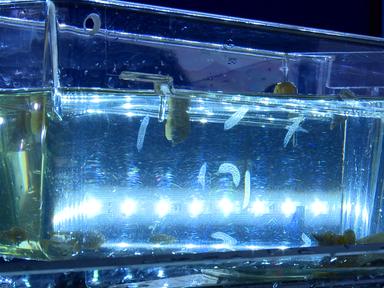
Low copper water is kept at 20 degrees Celsius, and the light dark cycle is 12 by 12 hours. At the VU University, the laboratory culture is maintained in breeding facility tanks with continuous water exchange. Under standard conditions, adult snails are fed lettuce at libido and separated according to their age class.
Once snails are removed from the breeding facility, they will be regarded in use and cannot be returned To the breeding tanks. Before starting the procedure, you'll need a stereo microscope, A dissection plate with pins, small surgical scissors, forceps, a syringe filled with magnesium chloride solution, and some paper towels to euthanize the snail, penetrate the foot with the injection needle at a 45 degree angle, and gently apply pressure continuously until the snail relaxes and remains extended. Remove the injection needle and make sure the snail is euthanized.
Next, take the forceps and carefully remove the shell. Following the curvature halfway gently scrape the ular muscle from the shell. Then gently twist the snail Out of its shell following the winding direction of the shell.
Now the snail has been removed from its shell and the shell can be discarded. Subsequently, place the snail on the dissection plate and place a pin through the back end of the foot. Then place a pin through the head.
Put some tension on the snail and place the pin in the plate. Now the snail is ready for dissection. Turn the light on for the stereo microscope and adjust the microscope.
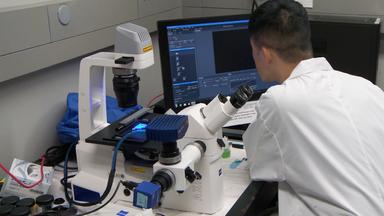
Before making the first incision, it is important to Localize the female por. This will later on be a reference point. Make a first incision just under the edge of the mantle And cut towards the Female por.
Make a turn around the bonno pore towards the head. Make sure only to cut the skin and not to hit any organs and cut in a straight line. For this study, we will dissect out the prostate gland And the seminal vesicles for seminal fluid and sperm respectively.
Please note that for full sperm and seminal fluid stores, the snails should be isolated for one week being fed ad libido. The dissection is the same as previously explained. The seminal vesicles are located in the posterior of the animal.
Next, the prostate gland will be suspended in saline And put on ice. Later on. These will be mixed with the treatment solutions.
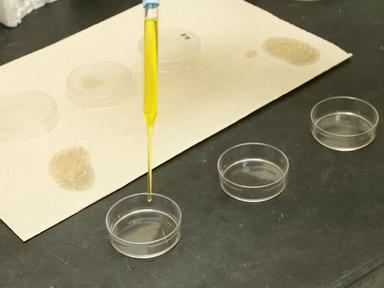
Before intravaginal injection, the collected sperm will be added to the seminal fluid or individual proteins In a relevant dose. For this artificial insemination technique, You'll need a one milliliter syringe Containing the test solution fit a injection needle on the syringes, making sure there are no bubbles stuck in the syringes for injection, use the silicon tube carefully. Slide the silicon tube over the injection needle.
Make sure the tube ist Pierced and remove the air from the tube. Before the injection, the snail has to be sedated. This will follow the same protocol as in chapter two.
The snail will be given a dose of two to three milliliters of 50 micro molars Of magnesium chloride. When the snail is properly sedated and relaxed, Lay it down in the mold to keep it in a stable position. Next, grab the end of the silicon tube with a pair of fine forceps and gently push it In the female por.
Then gently apply pressure to the Syringe and carefully inject the prescribed volume of the test solution. Wait half a minute for the pressure in the tube to spread into the female organ. After this, carefully remove the tube and put the snail in its own specific container.
After all, snails have been artificially inseminated. They can be transported to their experimental tanks and the bios bioassay can start. The snails will recover from sedation After a few hours.Bioassays.
For sexual selection, Experiments normally take two weeks before the biosa can be started. It is important to put all individuals in their own containers and label them. Next, measure the length of the shell of each snail.
This is a good indicator of their Size, which can have an effect on sexual behavior. After this, the snails are put in an Experimental tank. This tank has the same standard conditions as the breeding facility.
As discussed in chapter one, it's important to place the containers in the right orientation so the openings follow the water flow in the tank. During the bioassays, the snails have to be fed regularly. A standard amount of lettuce discs of lettuce are cut with a metal hole puncher.
A sufficient Dosage is two discs every other day. With the model species, lumia stauss, The snails should be checked for egg masses every other day. These Egg masses will be collected for measurements.
For the scanning of the eggs, you will need A laptop containing the scanner driver, a flatbed scanner, a standard millimeter scale, an egg mass spoon transferring plates and glass plates to lay on top of the egg masses. First, take the spoon and scrape the egg masses from the container walls. Egg masses that are opaque have just been laid and can't be used.
In this measuring event, place the egg masses on the transferring plates and repeat these steps until the plates are full. After this, put the egg masses on the glass tiles in the same order as the transferring plates. The egg masses will stick to the glass tile, turn it upside down and carefully place it on the flatbed scanner just under the scale.
Then apply pressure to the plates to squish the egg masses. This will even now add all the eggs so they will be scanned equally well. Before scanning, it is advised to adjust the settings For the best result.
For scanning, it is important to adjust the resolution to its maximum to make a preview scan To subsequently crop the working area, and finally, to adjust the brightness and contrast before making the final scan. After scanning, the egg masses will be placed in their own labeled Vials to mature and hatch. These vials have their water refreshed every other day to keep the oxygen at a proper level.
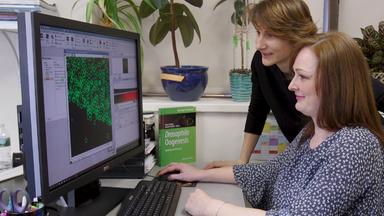
As more snails hatch, different techniques should be used to refresh the water. The best order is pouring or overflowing at first and later sucking The water out with a pipette open image JA spreadsheet program. To record the data and a photo from within image J first, use the zoom tool To navigate to the millimeter scale.
Zoom in and adjust the window so that a one Millimeter fills up the screen. Draw a line using the line tool between the two indicator lines. Next, navigate to analyze, then set scale.
In the popup menu, you'll see the Measured length adjust known distance to one and unit of to millimeters. Check the box global and close the window. Now that the scale has been set, we can zoom towards the first egg masses Up to 800%Use the elliptical tool to draw the circumference of the eggs.
Press D to draw the Circumference. This will help prevent measuring the same egg twice. Press M to measure the circumference.
A window will pop up after sufficient data has been Collected. The data window can be saved as an Excel file. Data can also be copied directly into a worksheet.
If the preferred measurements do not show in the popup window, this can be adjusted and analyzed. Set measurements, counting the individual eggs per egg masses can also be done with the help of the cell counter plugin. Navigate to plugins.
Then analyze and select cell counter. The cell counter window will pop up. Check the keep original box and press initialize.
A new counter window has appeared. Select the cross here tool from the toolbar. Then select a counter type in the cell counter menu.
By clicking in the cell counter window, the eggs will be counted. The total count can be found next to the counter type in the cell counter menu. Multiple egg masses can be counted with the cell counter.
Counter types can be added and removed if desired, This number has to be copied manually to a spreadsheet or press results, and a window will pop up. Showing all results. With this Method, we have shown how to collect seminal fluid proteins, how to test these in a meaningful way.
We have shown this using the complete prostate gland extract, but of course, the individual seminal fluid proteins can be tested in the same way. In addition, it is possible to look at other processes and egg laying. Results of our experiments have shown that there is a single seminal fluid protein called avios statin that mediates a reduction in egg lane.
In addition, we find that transfer of seminal fluid increases size or posts. Statin is the first fully characterized seminal fluid protein in a simultaneous hermaphrodite. While effects of seminal fluid have often been reported in species with separate sexes, our results highlight that seminal fluids are equally important in Hermaphrodites.
This video protocol demonstrates a method to study effects of seminal fluid in gastropods, using the hermaphroditic freshwater snail Lymnaea stagnalis.
Chapters in this video
0:00
Title
1:42
Breeding Facility
2:33
Dissection
5:46
Intravaginal Injection
7:32
Bioassay
11:01
Measuring and Counting Eggs
14:14
Conclusion
Related Videos
15.0K Views

19.4K Views

2.8K Views

6.2K Views

11.3K Views

8.2K Views

9.1K Views

8.0K Views

4.7K Views

2.6K Views